I use the changing light of quasars to study black holes, the galaxies that lens them, and the expansion of the Universe.
Working with Simon Birrer, I combine dynamical microlensing simulations with machine learning to turn irregular light curves into measurements and event forecasts for Rubin Observatory’s Legacy Survey of Space and Time.
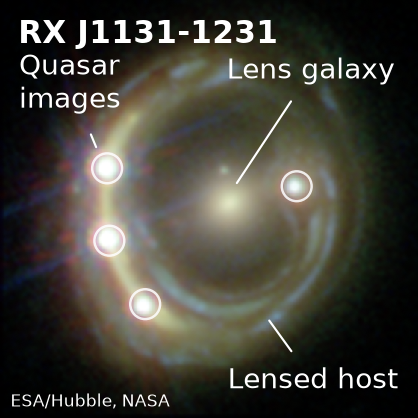
In RX J1131−1231, a foreground galaxy bends the light of a distant quasar into four images. Each follows a different path, so the same intrinsic variations arrive at different times.
Stars in the lens galaxy add a different microlensing signal to each image. Separating these signals lets us study accretion disks and compact objects while measuring the time delays that probe cosmic expansion.
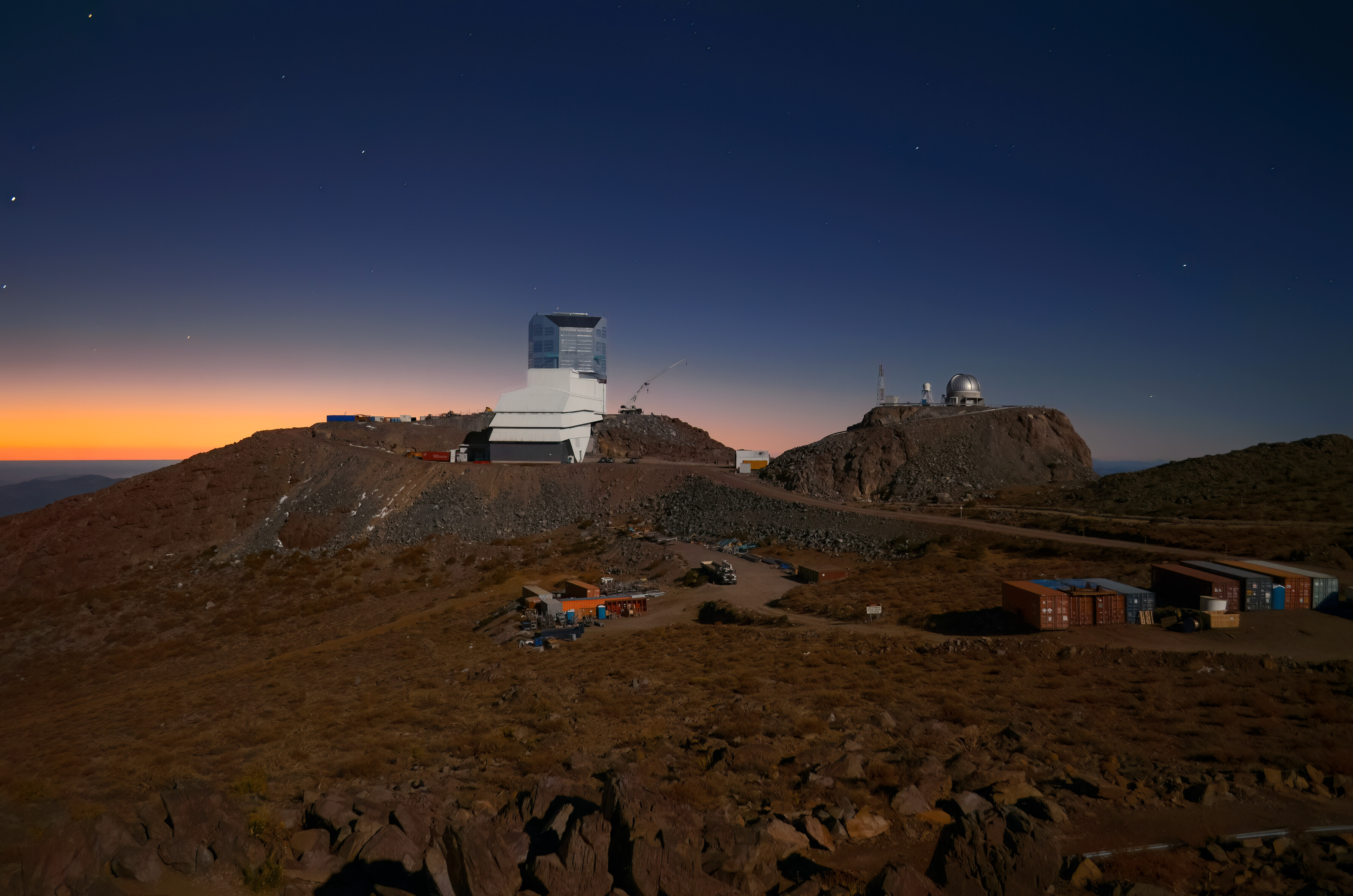
Rubin Observatory / LSST
A decade of light. New ways to read it.
The Legacy Survey of Space and Time repeatedly images the southern sky in six bands. For quasars, that means long, multicolor records of accretion and microlensing, with irregular sampling and seasonal gaps.
I am developing latent-SDE models trained on physical simulations to make use of these light curves as they grow. My goal is to connect survey monitoring to measurements of disk structure, microlens populations, and cosmological time delays, while guiding follow-up of the most informative events.
Recover light curves through gaps and separate shared intrinsic variability from image-specific microlensing.
Infer
Use the full time series to constrain physical parameters and their uncertainties.
Identify & forecast
Find past caustic crossings and predict future high-magnification events for multiband and spectroscopic follow-up.
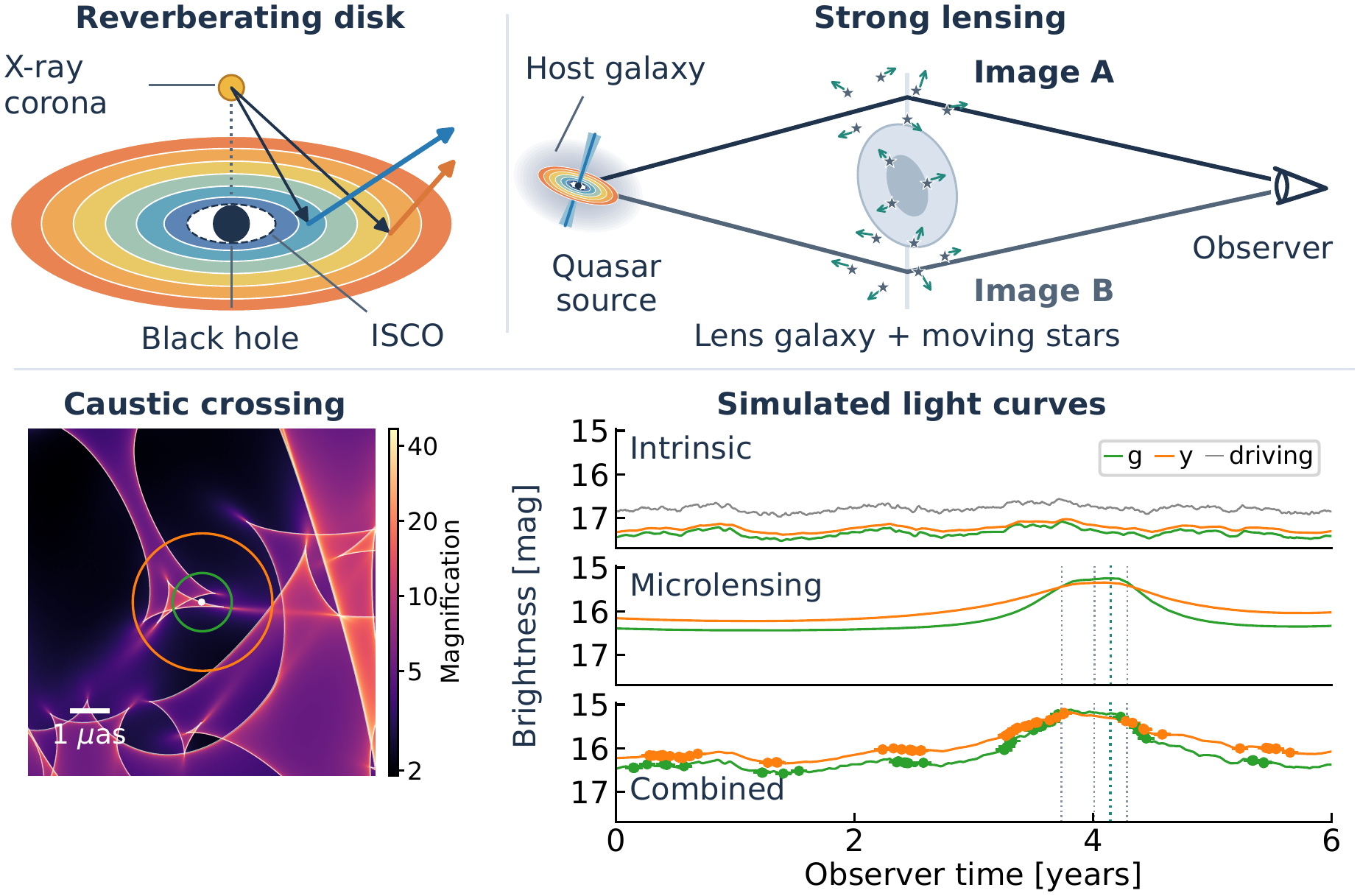
View figure ↗Two complementary probes of one accretion disk. Illustration and simulated Q2237+0305 light curves from my research.
01
Quasar accretion disks
Reverberation measures how an accretion disk responds to changing illumination. Microlensing magnifies different parts of the disk. Together, they can reveal its size, temperature structure, and inner-disk structure.
02
Dynamical microlensing
Stars move, so the magnification pattern evolves. I developed Microcaustics to make these simulations practical on GPUs and study how stellar motion and mass distributions affect inference.
03
Cosmology & compact objects
Strongly lensed quasars probe compact matter in distant galaxies and provide time delays for measuring cosmic expansion. My goal is joint time-series inference that accounts for microlensing rather than treating it only as a nuisance.
Machine learning for inference
From sparse observations to physical models.
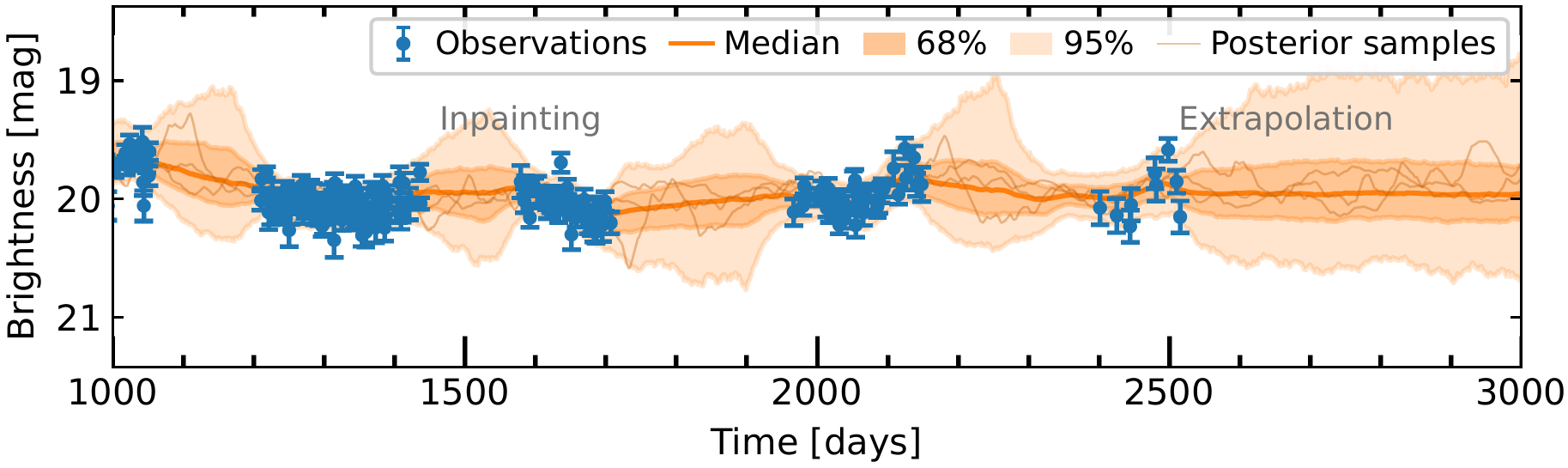
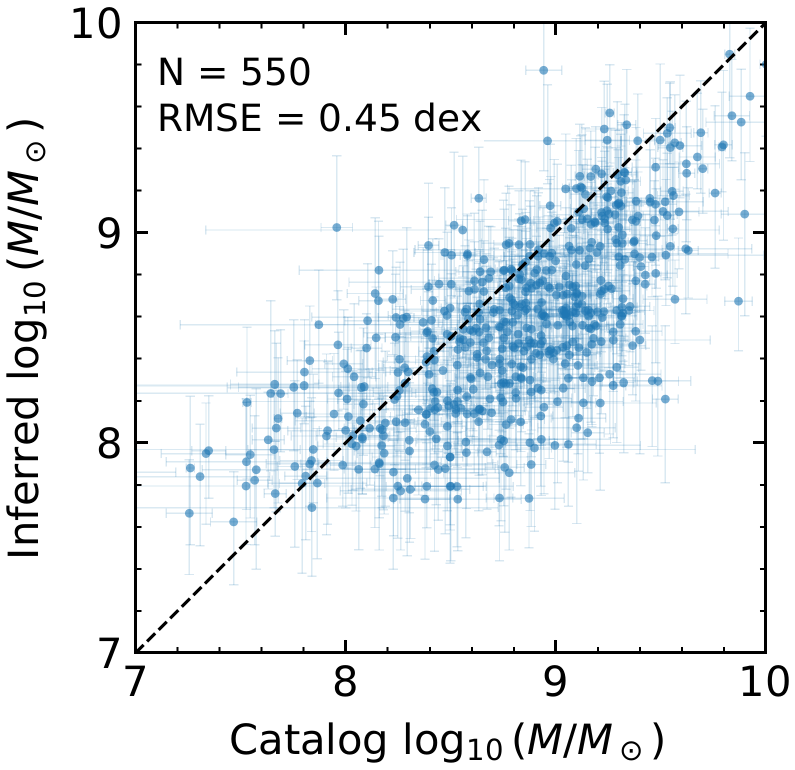
My latent stochastic differential equation (SDE) framework reconstructs irregular quasar light curves and infers black-hole and accretion-disk properties. It combines learned variability with a physical model of disk reprocessing.
Current work extends this approach to simulation-based inference with a pretrained Transformer encoder and tests it on observed ZTF and DES quasars. For lensed systems, I am developing methods to identify past crossings and forecast future high-magnification events for follow-up.
View figure ↗An observed, unlensed ZTF quasar. Blue points are data; orange curves and intervals are posterior reconstructions. From current work in preparation.View figure ↗Black-hole mass inference for 550 ZTF quasars with supplied redshifts, compared with catalog virial estimates. From current work in preparation.
The science in motion
A magnifying glass that moves.
These physical simulations show how evolving caustics change a quasar’s spectrum and reverberation response. Choose one of the two animations below, then select Play animation.
Microlensing changes more than brightness. The transfer function shows the disk’s relative response at different delays after a brief change in central illumination. Microlensing reweights this response, shifting its mean lag (arrows). Dashed curves show the unmicrolensed response and solid curves include microlensing. Below, capped points are mock LSST observations, with the caustic crossing marked at 600 days. Simulated Q2237+0305 image B.
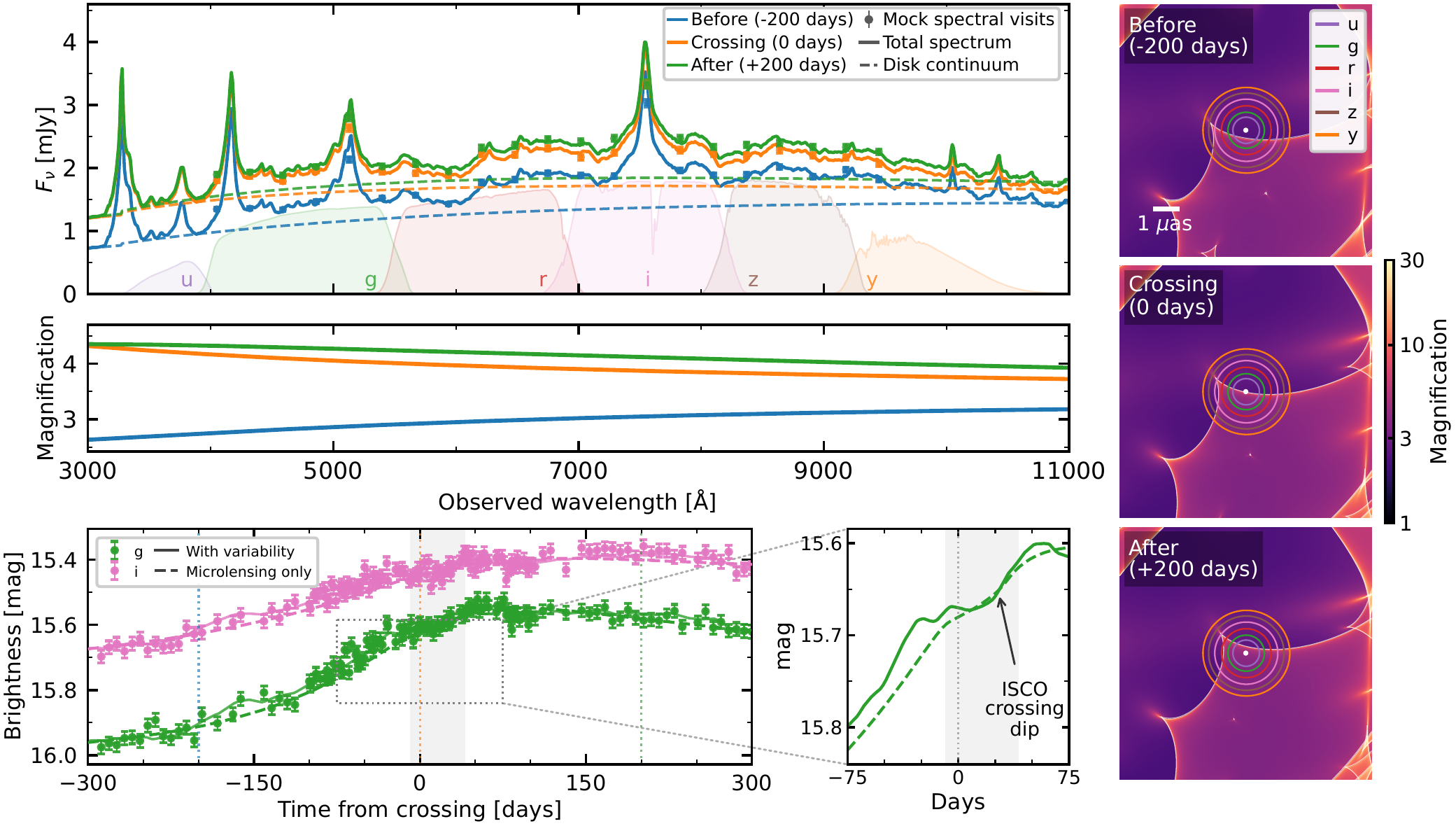
One crossing, many wavelengths. A simulated magnification pattern, evolving disk continuum, empirical emission lines, and Rubin bandpasses connect the source physics to daily multiband light curves. Points with capped error bars are mock LSST observations; the caustic-crossing time is marked. Simulated Q2237+0305 image B.
From forecasts to observations
Catching a caustic crossing.
Event forecasts can guide high-cadence multiband and spectroscopic follow-up, catching the fine structure of a crossing as a caustic scans the accretion disk.
View figure ↗Simulated Q2237+0305 image-B crossing with idealized mock follow-up observations. Spectra and multiband light curves probe different disk regions. In the light-curve panels, solid curves include intrinsic variability and dashed curves show microlensing alone. Time-delay-aligned image differences can suppress the shared intrinsic signal, helping reveal crossing structure.
Neglecting Dynamical Microlensing Can Bias Accretion Disk Size Measurements at a Population Level
J. Fagin et al. · In preparation
Physics-Embedded Simulation-Based Inference of Quasar Accretion Disk Reprocessing with Latent Stochastic Differential Equations
J. Fagin et al. · In preparation
Automated Caustic-Crossing Detection and Accretion-Disk Inference from Quasar Microlensing
J. Chan, J. Fagin, M. O’Dowd & S. Miskiewicz · Submitted to A&A
03 / Scientific software
Tools to make the science possible.
Open code, physical models, and worked examples for time-domain astronomy.
Python · PyTorch · Triton
Microcaustics
A GPU-accelerated simulator for dynamical gravitational microlensing of extended, evolving sources. Moving stars, stellar mass distributions, relativistic disks, spectra, and caustic labels can be combined in one light-curve workflow.
I co-lead a quasar-variability task force in the Rubin AGN Science Collaboration and participate in the Dark Energy and Strong Lensing Science Collaborations. I am also a member of the FutureLens Collaboration.
Teaching
I taught nine undergraduate physics laboratory sections at CUNY Lehman College in the Bronx, covering mechanics, electromagnetism, and physics of sound.
I develop open scientific-software tutorials and am interested in making time-series inference, GPU computing, and machine learning more accessible to astronomy students.
Across astronomy and AI
My latent-SDE work received a spotlight presentation at the ICLR 2023 Physics for Machine Learning Workshop. I have presented research at astronomy and machine-learning meetings, including Rubin science-collaboration meetings.
Let’s connect
Questions, ideas, or a new collaboration?
I’m interested in quasar physics, strong lensing, time-domain surveys, and machine learning for physical science.
 View HST image